
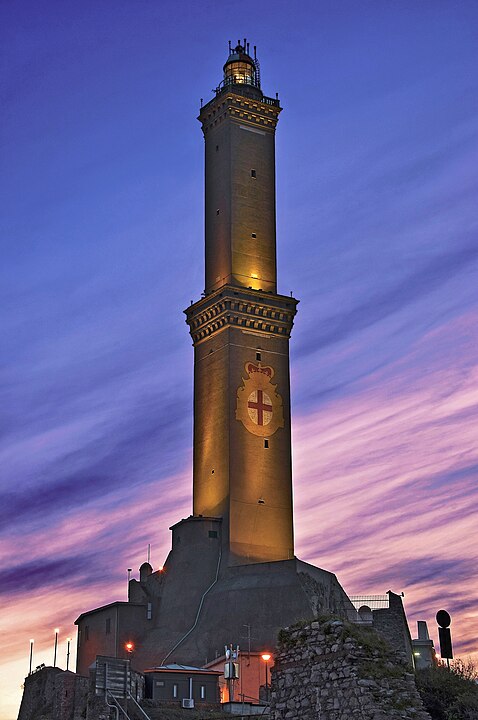

La Lanterna di Genova (o semplicemente "Lanterna", in genovese a Lanterna de Zena o a Lanterna) è il faro portuale del capoluogo della Liguria, la città un tempo definita la Superba o Dominante dei mari.
Da secoli strumento indispensabile alla navigazione notturna delle navi in entrata e uscita dal porto, la Lanterna è anche il simbolo di Genova, assumendo quasi un ruolo di totem di tutto ciò che riguarda la città, e come tale fa parte della storia cittadina.
Alta 77 metri e situata ad una quota sul livello del mare di 117 metri (considerando anche lo storico scoglio su cui è costruita), è il faro marittimo più alto d'Italia e del Mediterraneo e il secondo in Europa dopo il Faro dell’Île Vierge, nel dipartimento francese di Finistère, che nel 1902 tolse alla Lanterna il primato superandola in altezza di circa cinque metri. Risulta attualmente essere il quinto faro più alto del mondo e il secondo, sempre dietro quello di Île Vierge, fra quelli tradizionali, ossia costruiti dalle rispettive autorità portuali con lo scopo primario di supporto alla navigazione.[4]
L'edificio consiste in una torre su due ordini di sezione quadrata con terrazza alla sommità di ciascun ordine. Costruito originariamente probabilmente nel 1128 e ricostruito nella sua struttura attuale nel 1543, è considerato il terzo faro più antico al mondo tra quelli ancora in attività, dopo la Torre di Ercole a La Coruña e al faro di Kõpu sull'isola di Hiiumaa in Estonia.[5] Dai registri del faro si apprende che nel 1449, tra i custodi della Lanterna, venne nominato Antonio Colombo, zio paterno del famoso navigatore Cristoforo.
Posizione
La Lanterna sorge al margine orientale del quartiere di Sampierdarena, su uno scoglio isolato oggi interamente inserito all'interno del contesto portuale, estrema punta di quella che un tempo era la collina di promontorio di San Benigno che divideva l'ex comune di Sampierdarena da quello di Genova.
Il luogo in cui fu costruita veniva chiamato promontorio poiché, prima che la mano dell'uomo ridisegnasse i contorni della baia genovese, era circondato da tre lati dal mare. A ovest la collina delimitava l'originario porto di Genova, quello che oggi è il porto antico. Con il passare del tempo la collina ha assunto il nome di Capo di Faro o di San Benigno, dal nome dell'omonimo convento che su essa sorgeva. Di fatto oggi la collina non esiste più, rasa al suolo nella seconda metà degli anni '20 del XX secolo per creare nuovi spazi per la città, il porto stesso e i suoi insediamenti produttivi, e l'unica porzione che ne è rimasta è proprio la piccola propaggine rocciosa su cui sorge il faro.
Parallelamente, fra gli anni venti e gli anni trenta si sono svolti i lavori per l'ampliamento del Porto di Genova, con la creazione dei nuovi moli di Sampierdarena, realizzati tramite cospicui riempimenti a mare. In seguito all'operazione lo scoglio della Lanterna non è più direttamente sul mare ma a breve distanza da esso, in corrispondenza del molo di Ponte San Giorgio.
Collegamenti
La Lanterna, oltre che dai varchi portuali ad accesso controllato, è accessibile dalla città esclusivamente attraverso una passeggiata pedonale di circa 800 metri che si sviluppa per la maggior parte a sbalzo esternamente alle vecchie mura cittadine attraverso un percorso che sovrasta le banchine portuali, offrendo la possibilità di osservare da vicino le attività del porto.
La passeggiata inizia presso il Terminal Traghetti di Genova, servito dalle autolinee urbane AMT e dalla stazione della metropolitana di Dinegro, distante circa 400 metri. L'imbocco della passeggiata è situato inoltre a circa 1,5 chilometri dalla stazione ferroviaria di Principe e dal casello di Genova Ovest sull'autostrada A7.
L'edificio
La Lanterna è costituita da una torre su due ordini di sezione quadrata, costruita in pietra naturale estratta dalle cave di Carignano, con terrazza aggettante alla sommità sia del primo che del secondo tronco. Per raggiungere la sommità, al suo interno si sviluppa una scala in muratura con 365 gradini totali, di cui 172 aperti al pubblico per raggiungere la prima cornice, mentre la seconda cornice appartiene alla Marina Militare e non è visitabile.
Un tempo la Lanterna non era sola, ma aveva una "sorella minore", chiamata Torre dei Greci, eretta dopo la metà del 1200 e che si trovava come in tutti i porti all'estremo opposto dell'arco portuale, all'incirca nella zona dove attualmente sorgono i Magazzini del Cotone nel Porto Antico.
Il faro
Si tratta di un faro di secondo ordine. La lanterna è posta sulla sommità della torre ed è costituita da un ambiente a pianta circolare di 4 metri di diametro, con vetrata di 3,44 metri di altezza. L'ottica rotante, da 700 mm di distanza focale, è formata da 4 pannelli lenticolari con assi a 45° e 135°, parte diottrica con occhio di bue centrale, 3 elementi anulari superiori e 10 inferiori tutti interrotti lateralmente; su ogni pannello è sistemato un secondo pannello di prismi deflettori per il funzionamento aereo. Oltre all'ottica principale e al relativo impianto il faro è dotato di un gruppo elettrogeno di soccorso per l'alimentazione elettrica degli impianti di emergenza e del FIR (faro elettrico indipendente di riserva).
Storia
La Lanterna nel Medioevo
La prima torre, secondo alcune fonti non ufficiali, risale all'epoca medioevale (1128) ed era caratterizzata da una struttura architettonica formata da tre tronchi merlati sovrapposti. Purtroppo non si hanno riscontri ufficiali poiché i documenti del secolo XII, le prime cronache e gli atti ufficiali del nascente comune genovese, forniscono dati sicuri sulla torre di segnalazione, ma non la sua data esatta di costruzione. Alla sommità venivano accesi fasci di steli secchi di erica ("brugo") o di ginestra ("brusca") allo scopo di segnalare le navi in avvicinamento, i cui padroni dovevano pagare una tassa "pro igne facendo in capite fari"[7] al momento dell'approdo. La torre sorgeva lungo la strada di collegamento tra Genova e il ponente, la cosiddetta Via di Francia, che costeggiava l'arco portuale e il Promontorio, sull'ultima propaggine della costa di Sampierdarena, allora luogo di villeggiatura, su cui si affacciavano numerosi palazzi e ville nobiliari. All'epoca la strada era probabilmente a picco sul mare e passava a mare del faro; le rappresentazioni grafiche della strada la descrivono invece in una veste più recente, sicuramente non anteriore al XVII secolo, passante all'interno del faro attraverso la cosiddetta "tagliata", una profonda trincea scavata a monte della Lanterna.
A livello urbanistico la Lanterna era in quel periodo quindi relativamente lontana dalla città, e solo nel XVII secolo venne inglobata nella cosiddetta Cerchia Seicentesca, la poderosa cerchia di mura lunga quasi diciannove chilometri attorno alla città, quasi interamente esistente ancora ai nostri giorni.
La torre diventò protagonista della guerra tra guelfi e ghibellini, quando venne danneggiata da questi ultimi che tentarono di far scendere i guelfi che vi si erano rifugiati all'interno.
Era il 1318 e, tre anni dopo, nel 1321, si procedette a un primo consolidamento scavando un fossato a difesa. Nel 1326 vennero installate in entrambi i fari le prime lanterne alimentate a olio di oliva[8], per aiutare le navi a bene individuare l'ingresso alla città. Del 1371 è la prima raffigurazione grafica del fare di Capo Faro (perlomeno tra quelle giunte a noi), presente nella copertina della pergamena intitolata Manuale dei Salvatori del Molo e del Porto[9]. Attorno al 1400 la torre diventò anche prigione per ospitare come ostaggi, per cinque anni, il re di Cipro, Giacomo I di Lusignano, qui rinchiuso assieme alla moglie (che tra quelle mura diede alla luce il figlio Giano).
A meglio identificare la Lanterna con la città, nel 1340[10] venne dipinto alla sommità della torre inferiore lo stemma del Comune di Genova, opera del pittore Evangelista di Milano. Nel 1405 i sacerdoti guardiani della Lanterna posero sulla cupola un pesce e una croce di metallo dorato, simbolo di cristianità e nel 1413 un decreto dei "Consoli del Mare" stanziò un fondo di "lire 36" per assicurare la gestione del faro, divenuto ormai indispensabile per la sicurezza della navigazione.
La ricostruzione del 1543
Nel 1507, durante un periodo di dominio francese sulla città, re Luigi XII fece edificare ai piedi della Lanterna il "Forte Briglia", una fortificazione atta a ospitare la guarnigione dell'esercito invasore. Dal forte, con il supporto di un vascello da guerra che bloccava il traffico navale, nel 1513 i francesi assediarono il porto di Genova, liberato in seguito dalle forze genovesi capitanate da Andrea Doria, comandante del porto e della flotta. Durante questa battaglia la Lanterna venne pesantemente danneggiata dal fuoco amico dei colpi di bombarda esplosi dagli insorti genovesi contro i dominatori francesi.
Dopo trent'anni, nel 1543, la Lanterna venne ricostruita per volontà del doge Andrea Centurione Pietrasanta che fece finanziare i lavori dal Banco di San Giorgio. Il faro assunse così l'aspetto attuale, legato stilisticamente al mondo rinascimentale, applicando ai plinti di coronamento mensole aggettanti.
Fu posta in opera una nuova lanterna con cupola costruita in doghe di legno di rovere e ricoperta con fogli di rame e di piombo fermati con ben 600 chiodi di rame. Per l'occasione fu posta alla sommità della prima torre, all'interno del ballatoio, una targa a memoria della ricostruzione. La lanterna era formata da un'ampia vetrata i cui vetri, di notevole spessore e peso, erano forniti, così come già dal 1326, da maestri vetrai dapprima liguri e in seguito veneziani. I vetri della lanterna spesso esplodevano, si spaccavano o si inclinavano a causa della violenza del vento, delle oscillazioni della torre, della deformazione dei montanti in ferro per la caduta di fulmini e non ultimo per avvenimenti bellici, per cui ne erano richiesti in gran quantità. Ai fanalisti, custodi della Lanterna o Turrexani della torre, così definiti nei documenti del tempo, si faceva obbligo di vivere con la famiglia all'interno della torre e "di curare che i vetri fossero sempre tersi e puliti affinché la luce della lampada apparisse nitida e brillante".
Nel corso della storia la Lanterna è stata colpita più volte da fulmini; i danni più gravi si registrarono nel 1481, quando un fulmine colpì la torre uccidendo uno dei guardiani. Nel 1602 un fulmine colpì nuovamente la Lanterna, distruggendo la parte merlata della torre superiore. A seguito dell'episodio nel 1603, alla base esterna della torre superiore, venne murata, a scopo propiziatorio, una targa in marmo recante una scritta “Jesus Cristus rex venit in pace at Deus homo factus est”. Ancora oggi l'antica targa è murata su fronte a terra alla base della torre superiore, anche se risulta ormai quasi illeggibile.
Nel 1565 si ritornò a lavorare sulla cupola per renderla stagna e nel 1681 si ricostruì la cupola con legno di castagno selvatico ricoprendo il tutto con pece e stoppa, e infine con fogli di piombo stagnati a bordi sovrapposti.
L'assedio francese
Nel 1692 si ebbe poi la ricostruzione della vetrata distrutta dal bombardamento del 1684, attuato da Jean-Baptiste Colbert, marchese di Seignelay e dall'ammiraglio francese Abraham Duquesne su ordine di re Luigi XIV.
A seguito dei ripetuti danni causati dai fulmini e dagli avvenimenti bellici, nel 1711 la torre venne incatenata a mezzo di chiavarde e tiranti che ancora oggi sono visibili all'interno e nel 1791 vennero effettuati, alla base della prima torre, lavori di consolidamento per renderla più stabile. Al 1778 risale la costruzione di un impianto parafulmine ad opera del fisico padre Glicerio Sanxay, destinato a mettere fine ai numerosi danni provocati nell'arco di diversi secoli dai fulmini. Va detto che per secoli l'illuminazione è avvenuta con lampade di metallo o di vetro a stoppino.
Le innovazioni del Risorgimento e del Novecento
Nel 1840 venne realizzata un'ottica rotante su carro a ruote con lente di Fresnel e il 15 gennaio del 1841 venne acceso e avviato il nuovo sistema di illuminazione, il cui studio era stato eseguito dal Professor Plana. Il nuovo impianto si componeva di una lanterna di diametro di 4 metri, di forma dodecagonale a 4 ordini di cristalli piani sul lato verso mare, mentre la parte verso monte, nel settore fra 110° e 290°, era oscurata per mezzo di lamiere di rame di forma circolare. La base della Lanterna poggiava dal lato mare su lastre di piombo e dal lato terra su lastre di ferro; il tutto era rinforzato con montanti e traversini di ferro. Le principali caratteristiche erano: luce bianca fissa con portata a 15 miglia a cui erano sovrapposti splendori intervallati di un minuto visibili fino a 20 miglia circa.
Verso la fine dell'Ottocento il faro iniziò a essere ritenuto inadeguato in relazione all'arco di costa che doveva segnalare; nel 1881 si propose persino di declassarlo e di costruirne uno nuovo sul promontorio di Portofino, in questo meglio rispondente alle necessità della navigazione. Tale proposta venne tuttavia accantonata tre anni dopo, perché alla luce delle nuove possibilità che l'evoluzione tecnica consentiva, fu possibile adottare la soluzione di potenziare il faro di Genova in modo da ottenere la copertura della costa a est fino al settore del Faro del Tino e a ovest fino al settore del Faro di Capo Mele.
Dopo gli ulteriori aggiornamenti del 1898 e del 1913, nel 1936 si ebbe il passaggio all'elettrificazione moderna. Quindi nel 1956, dopo i danni ricevuti dall'aviazione statunitense e britannica nella Seconda guerra mondiale, la vecchia lanterna venne sostituita insieme all'ottica rotante e a tutti i congegni. Le dimensioni della nuova lanterna, per non modificare lo stile architettonico dell'antico monumento, furono similari alla precedente del 1841. Contestualmente venne inoltre sistemato un impianto per l'erogazione dell'energia di emergenza, messo in opera un montacarichi nell'angusto spazio della tromba delle scale e ritinteggiato lo stemma della gloriosa Repubblica Marinara sulla facciata della torre inferiore.
Come ultima modifica degna di nota, nel 1970 l'antico impianto di rotazione a peso motore, rimasto in sito quale riserva, fu sostituito da un impianto di rotazione elettrico e a seguito dell'apertura dell'aeroporto di Genova, posto a pochi chilometri della torre, alla sommità della cupola della Lanterna fu messo in opera un fanale intermittente rosso, di modesta portata, quale segnale di pericolo per gli aerei.
L'intero complesso, comprendente faro, fortificazioni, piazzali e parco urbano, è stato restaurato e reso accessibile al pubblico tra il 1995 e il 2004.
Nel 2024 è stata nominata lighthouse of the year dall'Associazione Internazionale delle Autorità per i Fari (IALA).[11]
La Porta della Lanterna
Dal momento che la Lanterna sorgeva sulla principale via di comunicazione fra Genova e il ponente, fino allo sbancamento del colle di San Benigno nel primo Novecento, già al momento della realizzazione delle cosiddette Mura Nuove seicentesche, venne realizzata una porta al loro interno esattamente ai piedi della Lanterna.
Quindi, come ricorda lo storico Federico Donaver, alla vecchia porta, mantenuta in sede fino alla sua demolizione nel 1877, ne fu affiancata una nuova costruita fra il 1828 e il 1831, chiamata Porta Nuova, Porta della Lanterna o Porta del Chiodo dal nome del suo progettista, il generale Agostino Chiodo. Come scriveva lo stesso Donaver infatti, la stessa porta e le vie adiacenti prendevano "nome della Lanterna o Faro pei naviganti che si eleva a 127 m sul livello del mare, la cui costruzione rimonta al 1549". La porta, a duplice fornice, era ricavata nel vivo della roccia era e aveva, originariamente, due ponti levatoi sostenuti da catene che scorrevano su ruote di bronzo, presto sostituiti, per le mutate necessità pratiche, con una passerella fissa. La facciata neoclassica è costruita in pietra di promontorio (ricavata dallo stesso colle alle spalle della Lanterna) e marmo bianco di Carrara, abbinamento che conta precedenti illustri nell'architettura della città. Notevole è l'appartato scultoreo, costituito dalle metope, delle teste di meduse poste in chiave di volta e dal gruppo dello stemma.
L'edificio della porta fu demolito nel 1935. A seguito di polemiche, per mantenere memoria della porta, la sola facciata venne smontata e ricostruita nell'attuale posizione, addossata al muraglione della Lanterna, una cinquantina di metri più a sud e ruotata di 90° rispetto alla posizione originaria, perdendo l'originaria funzione di porta.
Il Museo della Lanterna
Annesso alla torre sorge il Museo della Lanterna raggiungibile attraverso una passeggiata di circa seicento metri che costeggia le vecchie mura fino ai piedi del faro partendo da via Milano (parcheggio del terminal traghetti). L'area è raggiungibile dal vicino casello autostradale di Genova-Ovest (Sampierdarena).
Dopo una prima opera di riqualificazione del sito portata a termine nel 2004, nell'aprile del 2006 è stato completato a opera della Soprintendenza ai Beni Ambientali e Architettonici della Liguria il restauro e l'adattamento della Porta Nuova della Lanterna, adiacente alle fortificazioni che ospitano i locali del museo (in origine la porta aveva una rotazione di 90° in direzione nord, chiudendo l'accesso alla città dalla parte di ponente).
In particolare, il lavoro di restauro ha riguardato il riassetto e la pulizia degli elementi in marmo della porta, il riposizionamento di elementi distaccati dall'attico e la sistemazione della pavimentazione in pietra antistante la via di accesso. Contestualmente è stata ripristinata l'agibilità del parco urbano situato a nord della torre.
Alla base del faro, all’interno delle antiche fortificazioni si trova il Museo della Lanterna: nelle prime sale dette dei fucilieri, oggi si racconta la storia della Lanterna. Una parte del museo - ovvero le Sale dei cannoni - è riservata specificatamente all'uso e alla funzione dei fari navali e ai sistemi di segnalamento in mare. Un tipo particolare di lente - la lente di Fresnel, simile a quella adottata dal faro genovese - riproduce per il visitatore, con il proprio fascio di luce in rotazione, la visione in soggettiva dall'interno dell'ottica di un faro vero e proprio.
All'interno del museo sono ospitate periodicamente anche mostre tematiche, laboratori per famiglie e attività didattiche e per le famiglie, ed è possibile organizzare eventi corporate[12].
Nella stagione estiva, nel parco adiacente Porta Nuova della Lanterna, si svolgono rassegne teatrali, di musica e festival.
Insieme al Museo navale di Pegli, al Galata − Museo del mare e al Museoteatro della Commenda di San Giovanni di Pré (attivo tra il maggio 2009 e il 6 gennaio 2020, destinato a confluire nel Museo nazionale dell'emigrazione italiana), il Museo della Lanterna fa parte del polo culturale del Mu.MA - Istituzione Musei del Mare e delle Migrazioni, creata nel 2005.
ENGLISH:
The Lanterna of Genoa (or simply " Lantern ", in Genoese a Lanterna de Zena or a Lanterna ) is the port lighthouse of the capital of Liguria , the city once defined as the Superb or Dominant of the seas .
For centuries an indispensable instrument for the night-time navigation of ships entering and leaving the port , the Lanterna is also the symbol of Genoa, taking on the role of almost a totem for everything related to the city, and as such is part of the city's history .
77 metres high and situated at an altitude of 117 metres above sea level (also considering the historic rock on which it is built), it is the highest maritime lighthouse in Italy and the Mediterranean and the second in Europe after the Île Vierge lighthouse , in the French department of Finistère , which in 1902 took the primacy from the Lanterna by exceeding it in height by about five metres. It is currently the fifth highest lighthouse in the world and the second, always behind that of Île Vierge, among the traditional ones , that is, those built by the respective port authorities with the primary purpose of supporting navigation. [ 4 ]
The building consists of a tower on two orders of square section with a terrace at the top of each order. Originally built probably in 1128 and rebuilt in its current structure in 1543, it is considered the third oldest lighthouse in the world among those still in operation, after the Tower of Hercules in La Coruña and the Kõpu lighthouse on the island of Hiiumaa in Estonia . [ 5 ] From the lighthouse registers we learn that in 1449, among the keepers of the Lantern, Antonio Colombo, paternal uncle of the famous navigator Christopher , was named .
Position
The Lanterna stands on the eastern edge of the Sampierdarena district , on an isolated rock which is now entirely within the port area, the extreme tip of what was once the promontory hill of San Benigno which divided the former municipality of Sampierdarena from that of Genoa.
The place where it was built was called a promontory because, before the hand of man redesigned the contours of the Genoese bay, it was surrounded on three sides by the sea . To the west, the hill delimited the original port of Genoa, which is now the old port . Over time, the hill took the name of Capo di Faro or San Benigno, from the name of the convent of the same name that stood on it. In fact, today the hill no longer exists, razed to the ground in the second half of the 1920s to create new spaces for the city, the port itself and its production facilities, and the only portion that remains is precisely the small rocky spur on which the lighthouse stands.
At the same time, between the 1920s and 1930s, work was carried out to expand the Port of Genoa , with the creation of the new Sampierdarena docks , built through significant sea filling. Following this operation, the Lanterna rock is no longer directly on the sea but a short distance from it, in correspondence with the Ponte San Giorgio dock.
Links
The Lanterna, in addition to the controlled-access port gates, is accessible from the city exclusively via a pedestrian walkway of approximately 800 metres which develops mostly as a cantilever outside the old city walls along a path that overlooks the port docks, offering the possibility of observing the port 's activities up close .
The walk begins at the Genoa Ferry Terminal, served by the AMT urban bus lines and the Dinegro metro station , about 400 meters away. The start of the walk is also located about 1.5 kilometers from the Principe train station and the Genova Ovest toll booth on the A7 motorway .
Architecture
The Lantern consists of a tower on two levels with a square section, built in natural stone extracted from the Carignano quarries , with a terrace projecting from the top of both the first and second sections. To reach the top, inside there is a masonry staircase with a total of 365 steps, of which 172 are open to the public to reach the first cornice, while the second cornice belongs to the Navy and cannot be visited.
At one time the Lanterna was not alone, but had a "little sister", called the Torre dei Greci, built after the mid-1200s and which was located, as in all ports, at the opposite end of the port arch, approximately in the area where the Magazzini del Cotone in the Porto Antico currently stand .
The lighthouse
This is a second-order lighthouse. The lantern is located on the top of the tower and consists of a circular room 4 meters in diameter, with a 3.44 meter high glass window. The rotating optics, with a focal length of 700 mm, is made up of 4 lenticular panels with axes at 45° and 135°, a dioptric part with a central bull's eye , 3 upper annular elements and 10 lower ones all interrupted laterally; on each panel there is a second panel of deflector prisms for aerial operation. In addition to the main optics and the relative system, the lighthouse is equipped with a backup generator for the electrical power supply of the emergency systems and the FIR (independent electric reserve lighthouse).
History
The Lantern in the Middle Ages
The first tower, according to some unofficial sources, dates back to the medieval period ( 1128 ) and was characterised by an architectural structure made up of three superimposed crenellated trunks . Unfortunately there is no official evidence since the documents of the 12th century, the first chronicles and the official acts of the nascent Genoese municipality , provide reliable data on the signal tower, but not its exact date of construction. At the top, bundles of dry stems of heather (" brugo ") or broom (" brusca ") were lit in order to signal approaching ships, whose owners had to pay a tax " pro igne facendo in capite fari " [ 7 ] at the time of landing. The tower stood along the road connecting Genoa and the west, the so-called Via di Francia , which ran alongside the port arch and the Promontory, on the last offshoot of the coast of Sampierdarena, then a holiday resort, which overlooked numerous palaces and noble villas. At the time the road was probably sheer above the sea and passed by the lighthouse; the graphic representations of the road instead describe it in a more recent guise, certainly not prior to the 17th century , passing inside the lighthouse through the so-called "tagliata", a deep trench dug upstream of the Lanterna.
From an urban planning point of view, the Lanterna was at that time relatively far from the city, and only in the 17th century was it incorporated into the so-called Cerchia Seicentesca , the mighty circle of walls almost nineteen kilometres long around the city, almost entirely still existing today.
The tower became the protagonist of the war between the Guelphs and the Ghibellines , when it was damaged by the latter who attempted to make the Guelphs who had taken refuge inside come down.
It was 1318 and, three years later, in 1321 , an initial consolidation was carried out by digging a defensive moat. In 1326 , the first lanterns powered by olive oil were installed in both lighthouses [ 8 ] , to help ships to locate the entrance to the city. The first graphic representation of the Cape Lighthouse (at least among those that have reached us) dates back to 1371 and is present on the cover of the parchment entitled Manual of the Salvators of the Molo and the Port [ 9 ] . Around 1400 , the tower also became a prison to host, as hostages, for five years, the king of Cyprus , James I of Lusignan , locked up here together with his wife (who gave birth to her son Janus within those walls).
To better identify the Lantern with the city, in 1340 [ 10 ] the coat of arms of the Municipality of Genoa was painted on the top of the lower tower , the work of the painter Evangelista from Milan. In 1405 the guardian priests of the Lantern placed a fish and a cross of gilded metal on the dome, a symbol of Christianity , and in 1413 a decree of the "Consoli del Mare" allocated a fund of "36 lire" to ensure the management of the lighthouse, which had by now become indispensable for the safety of navigation.
The reconstruction of 1543
In 1507 , during a period of French rule over the city, King Louis XII had the "Forte Briglia" built at the foot of the Lantern, a fortification designed to house the garrison of the invading army. From the fort, with the support of a warship that blocked naval traffic, in 1513 the French besieged the port of Genoa, later liberated by Genoese forces led by Andrea Doria , commander of the port and the fleet. During this battle the Lantern was heavily damaged by friendly fire from bombards fired by Genoese insurgents against the French rulers.
After thirty years, in 1543 , the Lantern was rebuilt by order of the Doge Andrea Centurione Pietrasanta who had the works financed by the Banco di San Giorgio . The lighthouse thus took on its current appearance, stylistically linked to the Renaissance world , by applying projecting brackets to the crowning plinths .
A new lantern was erected with a dome built of oak slats and covered with sheets of copper and lead held in place with 600 copper nails. For the occasion, a plaque commemorating the reconstruction was placed at the top of the first tower, inside the gallery. The lantern was made up of a large glass window whose glass, of considerable thickness and weight, was supplied, as had been the case since 1326 , by master glassmakers, first Ligurian and then Venetian. The glass in the lantern often exploded, broke or tilted due to the force of the wind, the oscillations of the tower, the deformation of the iron uprights due to lightning strikes and, last but not least, war events, for which they were required in large quantities. The lighthouse keepers, custodians of the Lantern or Turrexani of the tower , as they were defined in the documents of the time, were required to live with their family inside the tower and " to ensure that the glass was always clean and clear so that the light from the lamp appeared clear and bright ".
Over the course of history, the Lantern has been struck by lightning several times; the most serious damage occurred in 1481 , when lightning struck the tower, killing one of the keepers. In 1602 , lightning struck the Lantern again, destroying the crenellated part of the upper tower. Following the episode in 1603 , a marble plaque bearing the inscription “Jesus Christus rex venit in pace at Deus homo factus est” was walled up at the external base of the upper tower for propitiatory purposes. The ancient plaque is still walled up on the ground floor at the base of the upper tower today, even though it is now almost illegible.
In 1565, work began again on the dome to make it watertight and in 1681 the dome was rebuilt with wild chestnut wood , covering everything with pitch and tow , and finally with sheets of tinned lead with overlapping edges.
The French Siege
In 1692, the stained glass window destroyed by the bombardment of 1684 was rebuilt , carried out by Jean-Baptiste Colbert, Marquis of Seignelay and the French admiral Abraham Duquesne on the orders of King Louis XIV .
Following repeated damage caused by lightning and war events, in 1711 the tower was chained with bolts and tie rods that are still visible inside today, and in 1791 consolidation work was carried out at the base of the first tower to make it more stable. The construction of a lightning rod system by the physicist Father Glicerio Sanxay dates back to 1778 , intended to put an end to the numerous damages caused by lightning over the course of several centuries. It must be said that for centuries the lighting was provided by metal or glass wick lamps.
The innovations of the Risorgimento and the twentieth century
In 1840 a rotating optics on a wheeled cart with a Fresnel lens was built and on 15 January 1841 the new lighting system, the study of which had been carried out by Professor Plana, was turned on and started up. The new system consisted of a lantern with a diameter of 4 metres, of a dodecagonal shape with 4 rows of flat crystals on the side facing the sea, while the part facing the mountain, in the sector between 110° and 290°, was darkened by means of circular copper sheets. The base of the Lantern rested on lead plates on the sea side and on iron plates on the land side; the whole was reinforced with iron uprights and crosspieces. The main characteristics were: a fixed white light with a range of 15 miles, on which were superimposed splendors spaced every minute, visible up to about 20 miles.
Towards the end of the nineteenth century the lighthouse began to be considered inadequate in relation to the arc of coast that it was intended to signal; in 1881 it was even proposed to downgrade it and build a new one on the promontory of Portofino , in this way better responding to the needs of navigation. This proposal was however set aside three years later, because in light of the new possibilities that technical evolution allowed, it was possible to adopt the solution of strengthening the Genoa lighthouse in order to obtain coverage of the coast to the east up to the sector of the Tino lighthouse and to the west up to the sector of the Capo Mele lighthouse .
After further updates in 1898 and 1913 , in 1936 the transition to modern electrification took place. Then in 1956 , after the damage suffered by the US and British air forces in the Second World War , the old lantern was replaced along with the rotating optics and all the mechanisms. The dimensions of the new lantern, so as not to modify the architectural style of the ancient monument, were similar to the previous one from 1841. At the same time, an emergency power supply system was installed, a freight elevator was installed in the narrow space of the stairwell and the coat of arms of the glorious Maritime Republic was repainted on the facade of the lower tower.
As a final noteworthy modification, in 1970 the old motor-weight rotation system, which had remained on site as a reserve, was replaced by an electric rotation system and following the opening of the Genoa airport , located a few kilometres from the tower, a small-range flashing red light was installed at the top of the Lanterna dome as a danger signal for aircraft.
The entire complex, including the lighthouse, fortifications, squares and urban park, was restored and made accessible to the public between 1995 and 2004 .
In 2024 it was named lighthouse of the year by the International Association of Lighthouse Authorities (IALA) . [ 11 ]
The Lantern Gate
Since the Lanterna stood on the main communication route between Genoa and the west, until the excavation of the San Benigno hill in the early twentieth century , already at the time of the construction of the so-called New Walls of the seventeenth century , a gate was built inside them exactly at the foot of the Lanterna.
: So, as the historian Federico Donaver recalls , the old gate, which remained in place until its demolition in 1877 , was flanked by a new one built between 1828 and 1831 , called Porta Nuova, Porta della Lanterna or Porta del Chiodo from the name of its designer, General Agostino Chiodo . As Donaver himself wrote, in fact, the gate itself and the adjacent streets took "the name of the Lantern or Lighthouse for sailors which rises 127 m above sea level, the construction of which dates back to 1549". The gate, with a double arch, was carved into the rock and originally had two drawbridges supported by chains that ran on bronze wheels, which were soon replaced, due to changing practical needs, with a fixed walkway. The neoclassical façade is built in promontory stone (obtained from the same hill behind the Lantern) and white Carrara marble , a combination that has illustrious precedents in the city's architecture. The sculptural decoration is noteworthy, consisting of the metopes , the heads of Medusas placed at the keystone and the coat of arms group .
The gate building was demolished in 1935. Following controversy, in order to preserve the memory of the gate, only the façade was dismantled and rebuilt in its current position, leaning against the Lanterna wall, about fifty metres further south and rotated 90° from its original position, losing its original function as a gate.
The Lantern Museum
Attached to the tower is the Lantern Museum, reachable via a walk of about six hundred meters that runs along the old walls up to the foot of the lighthouse starting from via Milano (ferry terminal parking lot). The area can be reached from the nearby Genova-Ovest motorway toll booth ( Sampierdarena ).
After an initial redevelopment of the site completed in 2004 , in April 2006 the Superintendency of Environmental and Architectural Heritage of Liguria completed the restoration and adaptation of the Porta Nuova della Lanterna, adjacent to the fortifications that house the museum premises (originally the gate had a 90° rotation in a northerly direction, closing off access to the city from the western side).
In particular, the restoration work involved the rearrangement and cleaning of the marble elements of the door, the repositioning of elements detached from the attic and the arrangement of the stone flooring in front of the access road. At the same time, the usability of the urban park located north of the tower was restored.
At the base of the lighthouse, inside the ancient fortifications, is the Lantern Museum: in the first rooms called the riflemen's rooms, today the history of the Lantern is told. A part of the museum - namely the Cannon Rooms - is specifically reserved for the use and function of naval lighthouses and signalling systems at sea. A particular type of lens - the Fresnel lens , similar to the one used by the Genoese lighthouse - reproduces for the visitor, with its rotating beam of light, the subjective view from inside the optics of a real lighthouse.
The museum also periodically hosts thematic exhibitions, workshops for families and educational activities for families, and it is possible to organize corporate events [ 12 ] .
In the summer season, the park adjacent to Porta Nuova della Lanterna hosts theatre, music and festival events.
Together with the Naval Museum of Pegli , the Galata − Museo del Mare and the Museoteatro della Commenda di San Giovanni di Pré (active between May 2009 and 6 January 2020, destined to merge into the National Museum of Italian Emigration ), the Lanterna Museum is part of the cultural hub of the Mu.MA - Institution of Museums of the Sea and Migrations, created in 2005. [ 13 ]
Lighthouse Management
The lighthouse, as a support instrument for maritime navigation, is completely controlled and managed by the Navy 's Lighthouse Zone Command based in La Spezia (which also takes care of all the lighthouses in the Upper Tyrrhenian Sea). The Navy has been managing all the lighthouses (including 128 offshore) along the approximately 8,000 km of Italian coasts since 1910 , using both military and civilian technicians.
The rest of the Lanterna, in its roles as a historical monument, city symbol and tourist attraction, was managed by the province of Genoa through the association Giovani Urbanisti - Fondazione Labò , which replaced the Fondazione Muvita on 2 July 2014 [ 14 ] , the latter owned by the Province of Genoa which had managed it since 1 July 2004 [ 15 ] . The association was responsible for opening the lighthouse and the annexed museum to the public, as well as for the ordinary maintenance of the complex, including the urban park around it and the access walk.
The Province of Genoa ceased its mandate on 31 December 2014 and passed the management to the Municipality of Genoa. The Labò Foundation with the Youth group continued to ensure the enhancement of the Monumental Complex according to the methods above until 5 January 2020.
Since March 2018, the monumental complex of the Lanterna has become part of the Mu.MA - Institution of Museums of the Sea and Migrations [ 16 ] .
Since 6 January 2020, the Youth Group of the Labò Foundation and part of the Friends of the Lanterna have formed a creative cultural enterprise born from the experience of managing the last five years: PHAROS light for heritage [ 17 ] , which in collaboration with the Friends of the Lanterna association promotes and supports initiatives for the enhancement of the symbolic monument of Genoa.
From 14 January 2020, the monumental complex can be visited from Tuesday to Sunday, thanks to the extension of the opening hours.


Follow us